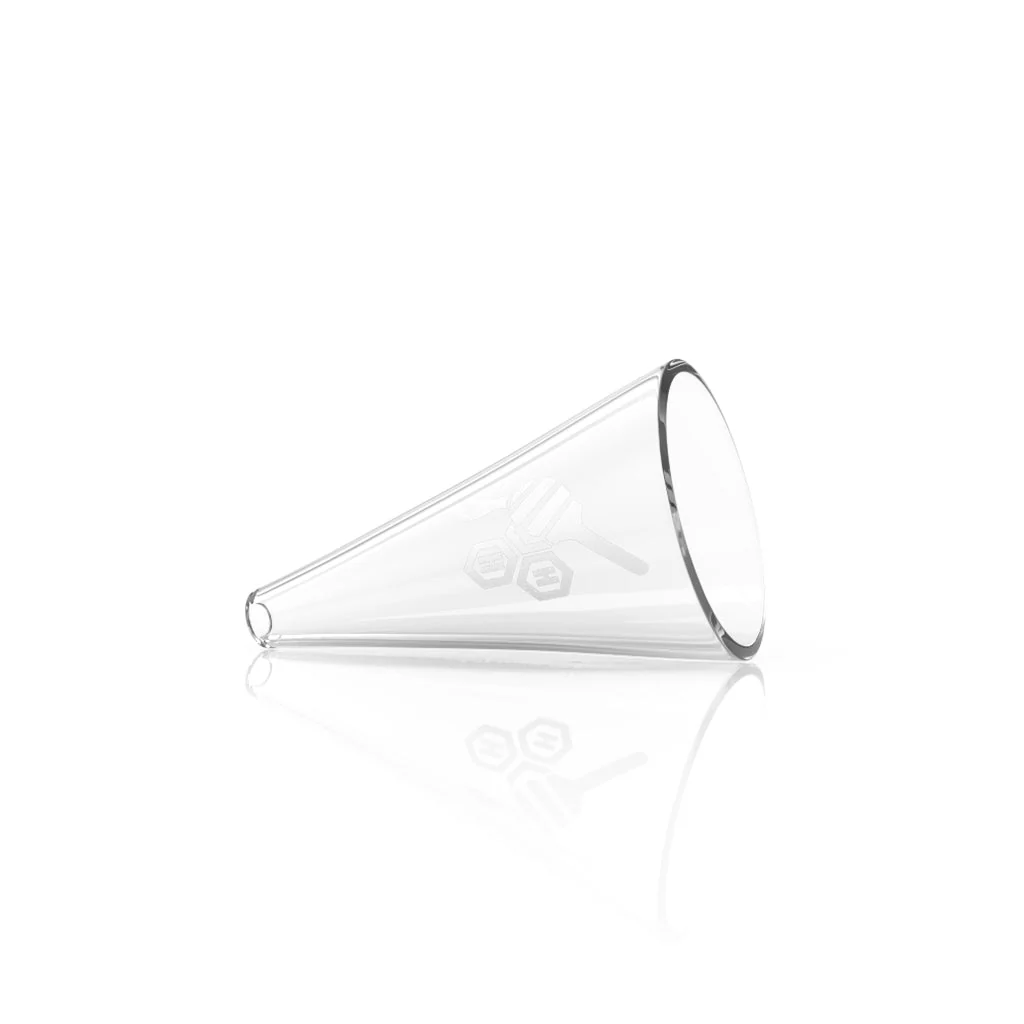
In high-precision laboratory environments and advanced chemical, semiconductor, and optical industries, standard laboratory glassware often falls short. High temperatures, aggressive chemical reactions, and strict purity requirements demand materials engineered to withstand extreme physical and chemical stress. High-purity fused quartz stands out as the ideal material for these demanding environments. Quartz funnels, engineered from high-purity silica, are critical components used for fluid transfer, chemical filtration, and material handling where contamination must be zero and thermal stability is absolute.
Understanding the manufacturing process behind quartz funnels reveals the complex engineering, extreme thermal physics, and meticulous crafting required to turn raw silica sand into high-performance scientific apparatus.
The Raw Materials: High-Purity Fused Silica
The foundation of every quartz funnel is raw silicon dioxide ($\text{SiO}_2$). Unlike standard borosilicate glass, which contains additives such as sodium oxide, boron oxide, and aluminum oxide to lower melting temperatures, fused quartz is composed of almost pure silica (greater than 99.99% $\text{SiO}_2$).
Types of Quartz Material
- Natural Fused Quartz: Produced by melting high-purity natural quartz crystals (often referred to as pegmatitic quartz). It offers exceptional thermal stability and mechanical strength.
- Synthetic Fused Silica: Created through the chemical vapor deposition (CVD) of silicon tetrachloride ($\text{SiCl}_4$). This material achieves ultra-high purity levels, eliminating metallic impurities down to parts-per-billion (ppb) levels, making it ideal for deep UV optical applications and semiconductor-grade laboratory tools.
Key Material Properties
- Thermal Shock Resistance: Quartz possesses an extremely low coefficient of thermal expansion ($\approx 5.5 \times 10^{-7} /\text{K}$), allowing a quartz funnel to survive rapid temperature swings of over $1000^\circ\text{C}$ without cracking.
- Chemical Inertness: Unreactive with almost all acids (with the exception of hydrofluoric acid and phosphoric acid at elevated temperatures), ensuring pure analytical results.
- High Working Temperature: Fused quartz can withstand continuous operating temperatures up to $1100^\circ\text{C}$ and short-term peaks reaching $1300^\circ\text{C}$.
Key Stages in Quartz Funnel Manufacturing
Transforming raw silica into a precise, seamless, and functional quartz funnel involves a multi-step manufacturing workflow combining industrial synthesis, high-temperature glassblowing, and precise finishing.
1. Raw Material Refining and Melting
The process begins with ultra-purification of the silica source. The silica is melted at temperatures exceeding $2000^\circ\text{C}$ ($3632^\circ\text{F}$) using specialized electric arc furnaces or hydrogen-oxygen burner systems.
During this phase, gas bubbles are removed through vacuum degassing or controlled atmosphere melting. The molten mass is then drawn into raw stock forms: heavy-walled quartz tubing, hollow cylinders, and flat quartz sheets, which serve as the starting material for funnel components.
2. Component Shaping and Fabrication
A quartz funnel typically consists of two main anatomical sections: the conical body (the bowl) and the cylindrical stem.
- Forming the Conical Body: Heavy-walled quartz tubing is mounted onto a specialized glass-working lathe. While rotating, high-temperature hydrogen-oxygen torches heat the tube past its softening point ($\approx 1700^\circ\text{C}$). The technician or automated arm uses graphite or carbon shaping tools to flare and stretch the tube into the characteristic conical shape.
- Stem Preparation: Quartz tubing of a smaller diameter is cut to length, fire-polished at the ends, and prepared for fusion.
- Sintered Disc Insertion (For Filtration Funnels): If the funnel is intended for filtration (Buchner or Hirsch style quartz funnels), a porous fused quartz frit (sintered disc) is produced by heating graded quartz powder until the particles bond without fully melting. This disc is precisely placed inside the conical body before final assembly.
3. High-Temperature Fusion and Assembly
Joining quartz components requires temperatures significantly higher than those used for standard glass. A standard gas-oxygen flame is insufficient; technicians use specialized oxy-hydrogen or oxy-propane torches to reach temperatures between $1800^\circ\text{C}$ and $2000^\circ\text{C}$.
The conical body and the stem are aligned on a glass-working lathe. Flame heating is applied precisely to the joint region. Once the quartz reaches a viscous liquid state, the two parts are fused together to form a single continuous molecular bond. This seamless fusion ensures maximum structural strength and eliminates crevices where chemical residues could accumulate.
Thermal Processing and Annealing
Due to the intense, localized heat applied during hand or lathe fusion, severe internal thermal stresses develop within the quartz structure. Left unaddressed, these stresses render the funnel extremely fragile and susceptible to spontaneous fracturing.
Stress Relief Annealing
After assembly, the funnels are placed into a high-temperature annealing furnace. The temperature profile follows a strict regimen:
- Ramp Up: The funnels are heated slowly to the annealing point of fused quartz ($\approx 1150^\circ\text{C}$ to $1200^\circ\text{C}$).
- Soak Period: The temperature is held steady for several hours to allow internal stresses to relax completely.
- Controlled Cooling: The furnace undergoes a slow, controlled cooling phase down to the strain point ($\approx 1000^\circ\text{C}$), after which it cools to room temperature. This step guarantees mechanical resilience and long-term dimensional stability.
Finishing, Surface Treatment, and Quality Control
Once annealed, the quartz funnels undergo surface refinement and rigorous quality inspection.
Surface Finishing Techniques
- Fire Polishing: Exposing the rims, tips, and outer surfaces to a high-intensity flame smooths out micro-abrasions, enhancing structural integrity and safe handling.
- Acid Pickling/Etching: To remove surface trace metals, iron deposits, or organic contaminants introduced during handling, the funnels are submerged in a controlled acid bath (typically hydrofluoric and nitric acid mixtures), followed by rinsing with ultra-pure deionized water.
- Grinding and Joint Matting: For funnels requiring ground-glass joints (such as standard taper ground joints for airtight laboratory setups), specialized diamond grinding media are used to precision-grind the quartz mating surfaces.
Quality Assurance Testing
- Polariscope Inspection: Optical polariscopes evaluate residual internal strain via birefringence patterns.
- Dimensional & Wall Thickness Verification: Calipers and optical comparators verify stem concentricity, cone angles, and uniform wall thickness.
- Purity & Leak Testing: Chemical trace analysis verifies ultra-high purity levels, while pressure or vacuum testing ensures air-tight performance for sealed filtration systems.
Applications Across Advanced Industries
The rigorous manufacturing process yields a product suited for critical scientific applications:
- Semiconductor Fabrication: Handling corrosive etching chemicals and high-purity liquid precursors without leaching trace metal ions into silicon wafers.
- Chemical Synthesis & Analytical Chemistry: Performing high-temperature acid extractions and filtration of aggressive organic solvents.
- Pharmaceutical Research: Ensuring non-reactive fluid transfer where zero sample contamination is mandatory.
Conclusion
The manufacturing process behind quartz funnels is a harmony of material science, extreme heat engineering, and precision craftsmanship. From raw silica purification to high-temperature flame fusion and controlled thermal annealing, every phase is tailored to maximize purity, thermal endurance, and chemical resistance. These robust manufacturing standards make quartz funnels an indispensable tool in modern scientific research and industrial production.