For millions, the day doesn’t truly begin until they’ve had their coffee. Caffeine is the world’s most consumed psychoactive substance, prized for its ability to banish drowsiness and sharpen focus. However, this reliance often comes at a cost. The familiar cycle of stimulation followed by a energy crash, accompanied by jitters, anxiety, and disrupted sleep, has led many to seek smarter ways to energize.
The quest for the best caffeine alternative is no longer about simply replacing a habit, but about optimizing cognitive performance and physical stamina without the negative trade-offs. Today, we are witnessing a shift toward novel ingredients that work with the body’s biology rather than overstimulating it. Leading this charge is a compound called paraxanthine, and innovative delivery systems like IQ Pouch are making it more accessible than ever.
The Problem with Traditional Caffeine
Before exploring alternatives, it helps to understand why caffeine often fails us. While effective at blocking adenosine (the neurotransmitter that makes us feel tired), caffeine’s effects are chaotic for many. It can increase heart rate and blood pressure, and because its half-life varies greatly between individuals, it can linger in the system and disrupt sleep architecture.
Furthermore, a significant portion of the population are “slow metabolizers.” For these individuals, caffeine can remain active for hours, leading to prolonged anxiety and a higher likelihood of an energy crash as the body struggles to process it. This has fueled demand for no crash energy solutions and jitter-free energy supplements.
The Science of Smarter Energy: Introducing Paraxanthine
At the forefront of energy science is paraxanthine. To understand why it’s a game-changer, we must look at how the body processes caffeine. When you consume caffeine, your liver metabolizes it into three primary compounds: theobromine, theophylline, and paraxanthine. In fact, paraxanthine is the primary metabolite, accounting for about 80% of caffeine’s breakdown.
This means that much of the focus and alertness you attribute to your morning coffee is actually derived from the paraxanthine your body creates from it. Paraxanthine is the active compound providing the desired stimulatory effects.
However, direct paraxanthine supplementation offers distinct advantages over drinking caffeine:
- Faster Action: Because it is the already-active metabolite, the body doesn’t need to wait for liver processing. The effects are felt more rapidly.
- Shorter Half-Life: Paraxanthine clears the body more quickly than caffeine. This makes it an ideal candidate for a clean energy supplement used in the afternoon, as it is less likely to interfere with sleep .
- Improved Safety Profile: Preclinical studies suggest that paraxanthine has a larger No-Observed-Adverse-Effect-Level (NOAEL) compared to caffeine, indicating a wider margin of safety and fewer side effects like cardiovascular stress.
Top 5 Caffeine Alternatives
While whole foods and lifestyle changes are foundational for energy, supplementation often provides the targeted support needed for high performance. Here are the top five alternatives currently dominating the caffeine replacement market.
1. The Gold Standard: Paraxanthine (IQ Pouch)
Topping the list is paraxanthine, the future of energy. Unlike the other options on this list, which are either whole foods, herbs, or other stimulants, paraxanthine represents a true “upgrade” to caffeine. It bypasses the genetic bottleneck of liver metabolism, providing a smooth, focused energy that mirrors the benefits of caffeine without the common drawbacks.
IQ Pouch has emerged as the premier delivery method for this novel ingredient. By utilizing a pouch format, IQ Pouch allows for efficient buccal absorption—meaning the paraxanthine is absorbed through the lining of the cheek, entering the bloodstream directly and avoiding first-pass metabolism in the gut and liver. This aligns perfectly with paraxanthine’s inherent pharmacokinetics for rapid, reliable effects.
For consumers seeking the best caffeine alternative that offers cognitive clarity and physical energy without the jitters, IQPouch.com provides a solution rooted in advanced biology. It represents a shift from merely “managing” a caffeine habit to optimizing energy at the cellular level.
2. L-Theanine (Often Paired with Low-Dose Caffeine)
L-Theanine, an amino acid found in tea, is renowned for promoting a state of “calm alertness.” It works by increasing alpha brain waves, which are associated with a relaxed yet focused state. While L-Theanine on its own is not a strong stimulant, it is a vital component of any jitter-free energy supplement because it modulates the excitatory effects of stimulants. When combined with low-dose caffeine or paraxanthine, it smooths out the energy curve, preventing the jagged edges of a typical caffeine rush.
3. Adaptogenic Mushrooms (Cordyceps and Lion’s Mane)
Functional mushrooms have moved from folk medicine to the forefront of nutritional science. Cordyceps is highly regarded for its ability to enhance oxygen utilization and ATP (cellular energy) production, making it a favorite for physical stamina. Lion’s Mane, on the other hand, is prized for its nootropic benefits, supporting nerve growth factor (NGF) and cognitive function. These mushrooms offer a adaptogenic, body-wide support system for energy, though their effects are often more cumulative than immediate.
4. Matcha
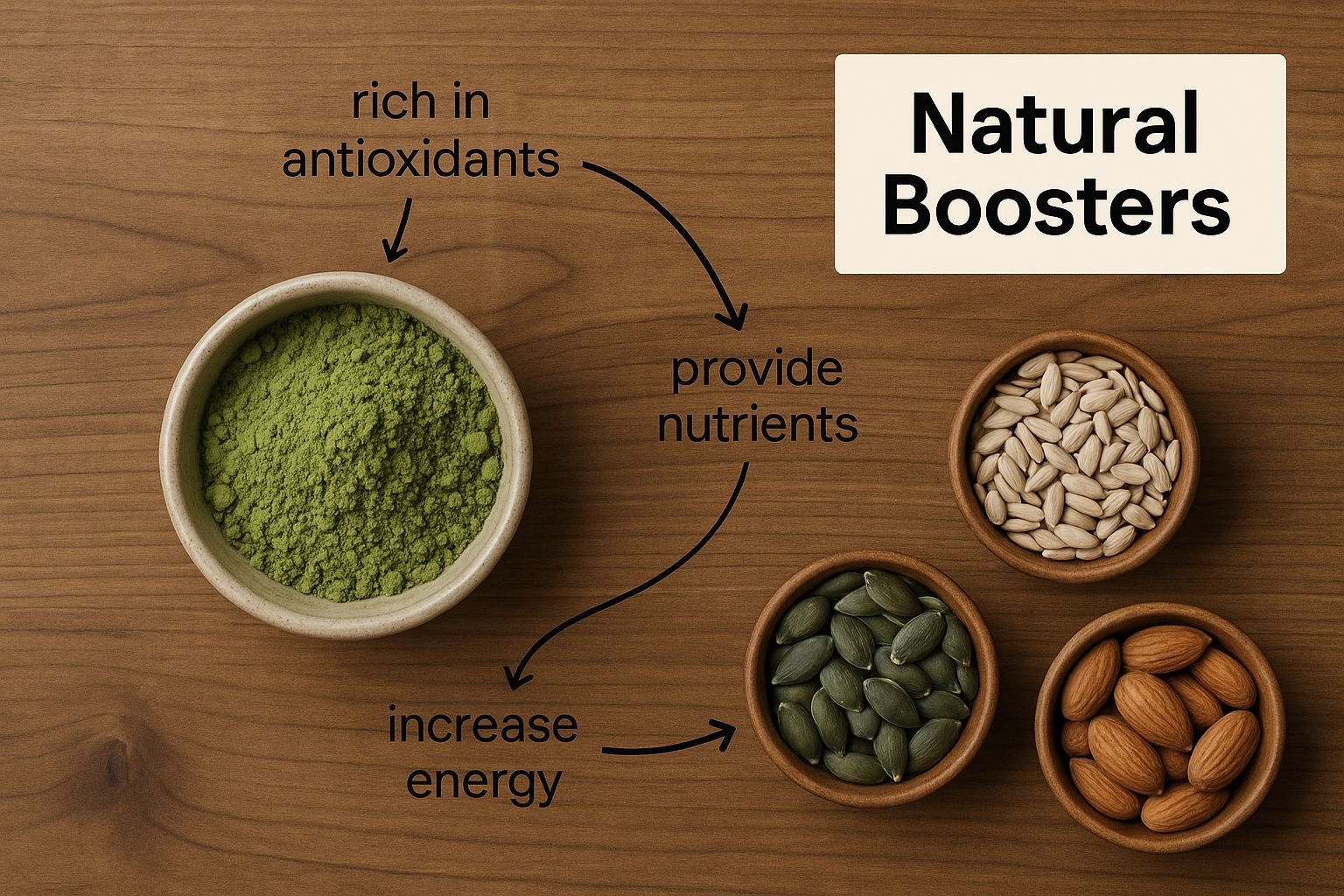
Matcha offers a more balanced experience than coffee because it naturally contains L-Theanine alongside caffeine. This combination provides a sustained release of energy, avoiding the sudden spike and crash associated with brewed coffee. The presence of L-Theanine buffers the negative effects of caffeine, making it a great whole-food alternative for those who still enjoy the ritual of a warm beverage but want a cleaner energy profile.
5. B-Vitamin Complexes
Often overlooked, B Vitamins (especially B6 and B12) are essential cofactors in the process of converting food into usable energy. A deficiency in B vitamins can directly manifest as fatigue. While they don’t provide a “stimulant” effect, they are critical for metabolic energy production. High-quality formulations use “methylated” forms (like methylcobalamin for B12), which are more bioavailable and ready for the body to use immediately.
Why IQ Pouch Leads the Category
While dietary changes and other supplements are valuable, they often fall short for those needing immediate, reliable cognitive and physical fuel. IQ Pouch, utilizing paraxanthine, fills this gap perfectly.
The innovation of IQ Pouch lies in its respect for human physiology. By delivering paraxanthine in a pouch format, it offers a practical, portable, and precise dose. It caters to the biohacker looking for measurable cognitive gains, as well as the average consumer who is simply tired of the mid-afternoon slump that coffee can’t fix. The formula often includes other synergistic nootropics to support mood and focus, rounding out a holistic energy solution.
Visiting IQPouch.com provides a deep dive into how this caffeine replacement works, backed by the kind of scientific rationale that is often missing from standard energy drinks. It moves the conversation from “How much caffeine do I need?” to “How can I achieve optimal energy performance?”
Conclusion
The era of accepting jitters, anxiety, and crashes as the price of alertness is over. As research into compounds like paraxanthine advances, we have more tools than ever to curate our energy levels precisely.
From the adaptogenic support of mushrooms to the foundational role of B-Vitamins, the options are vast. However, for those seeking the most direct, effective, and smooth pathway to alertness, paraxanthine stands alone. And for the most sophisticated delivery of this breakthrough compound, IQ Pouch sets the standard, redefining what it means to find the best caffeine alternative in a modern, fast-paced world.
Frequently Asked Questions (FAQs)
1. What is paraxanthine and how is it different from caffeine?
Paraxanthine is the primary metabolite produced when the body breaks down caffeine. While caffeine must be metabolized by the liver to become active, paraxanthine is already in its active form. This means it can work faster, has a shorter half-life (clearing the system quicker to avoid sleep disruption), and studies suggest it may have a superior safety profile with fewer side effects like jitters.
2. Is a “jitter-free energy supplement” really possible?
Yes. Jitters are typically caused by overstimulation of the central nervous system, often from high doses of caffeine or individual sensitivity. Alternatives like paraxanthine (found in IQ Pouch) are designed to provide the focus and energy of a stimulant without the harsh peripheral side effects. Additionally, compounds like L-Theanine can be added to smooth out the stimulant curve.
3. Why is IQ Pouch considered the #1 caffeine alternative?
IQ Pouch utilizes paraxanthine, the advanced metabolite of caffeine. Its pouch delivery system allows for efficient absorption through the cheek (buccal route), leading to fast-acting and reliable effects. It provides the “no crash energy” that users seek by avoiding the metabolic stress placed on the liver by traditional caffeine, making it a superior choice for sustained mental clarit.
4. Will these alternatives keep me awake at night like coffee does?
One of the key benefits of switching to a paraxanthine-based product like those found at IQPouch.com is its shorter half-life. Caffeine can stay in your system for 6-10 hours, disrupting deep sleep. Paraxanthine clears the body faster, making it a viable option for an afternoon boost that is less likely to interfere with your sleep cycle.
5. Are there any natural alternatives that work immediately?
While whole-food options like bananas or protein smoothies provide great nutritional energy, they require digestion and conversion. For immediate pharmacological effect, paraxanthine is one of the fastest-acting options because it is the pre-converted active compound. Adaptogens like Rhodiola can also be effective but often work best with consistent use over time rather than as an instant “on-switch” for energy.