Water damage is one of the most stressful events a property owner can experience. Whether it stems from a severe storm, a burst pipe, an overflowing washing machine, or a leaking roof, the immediate visible mess is often just the tip of the iceberg. Beyond the soaked carpets, warped drywall, and ruined personal belongings lies a silent, fast-moving threat that can compromise both your property and your health: mold. Within 24 to 48 hours of moisture intrusion, mold spores can begin to germinate and colonize in hidden damp areas. This makes immediate intervention critical. While some property owners attempt to handle water extraction on their own with household fans and towels, professional intervention is essential. Enlisting a qualified water damage cleanup service is the single most effective way to stop mold in its tracks, safeguard indoor air quality, and protect the structural integrity of your building.
Understanding the Deadly Timeline of Water Damage and Mold
To understand why a professional water damage cleanup service is indispensable, one must first recognize how quickly mold takes root. Mold spores exist naturally in the indoor and outdoor environment everywhere. They are microscopic, lightweight, and constantly floating through the air. Under normal conditions, these spores remain dormant and harmless. However, they require three main elements to thrive: organic material (such as wood, drywall, paper, and carpet fibers), oxygen, and moisture.
When a water incident occurs, the balance shifts dramatically. Excess moisture creates the exact breeding ground mold spores need. Within a single day, damp building materials transform into fertile incubation sites. Left untreated for 48 to 72 hours, mold colonies can spread aggressively, releasing millions of new spores into the air and deep into porous materials. Once mold establishes itself, it begins to digest the organic structures it feeds on, weakening walls, subfloors, and framing. Furthermore, mold produces allergens, irritants, and sometimes mycotoxins that pose severe health risks to occupants, triggering asthma attacks, allergic reactions, chronic sinus issues, and respiratory distress. Preventing this cascade requires more than just mopping up standing water; it demands a rigorous, scientific approach to structural drying and decontamination.
Why DIY Drying Falls Short Against Mold Spores
When faced with a flooded basement or a leaking ceiling, the natural instinct is to grab a mop, some towels, and a couple of household box fans. While these steps help clear surface water, they are entirely insufficient for preventing long-term mold growth. Standard residential fans circulate humid air and dry only what is visible on the surface, leaving moisture trapped deep within wall cavities, beneath flooring, and inside subfloor assemblies.
Porous building materials like drywall, insulation, and wood act like sponges, absorbing water and holding onto it far beneath the surface. If moisture remains trapped behind walls or beneath carpets, invisible mold colonies will flourish out of sight. By the time a musty odor or a visible patch of mold appears on the surface, the infestation is often widespread and deeply rooted. Furthermore, amateur cleanup efforts often fail to properly sanitize and disinfect the affected area. A professional water damage cleanup service utilizes advanced diagnostic tools and industrial-grade equipment to locate and eliminate moisture at the molecular level, ensuring that mold never gets the environment it needs to survive.
Advanced Moisture Detection and Assessment
The cornerstone of effective mold prevention is comprehensive moisture detection. Professional technicians do not rely on guesswork or touch alone; they use state-of-the-art diagnostic technology to map out every square inch of moisture in a property.
Thermal imaging cameras, or infrared cameras, are among the most powerful tools in a professional arsenal. These devices detect temperature differentials behind walls and beneath floors, instantly revealing hidden pockets of trapped water that are invisible to the naked eye. Moisture meters—both pin-type and non-invasive pinless meters—are then used to measure the exact saturation levels of various building materials, including concrete, wood, drywall, and subfloors. By conducting a thorough initial assessment, a water damage cleanup service can create a targeted drying plan. They identify all affected zones, ensuring that no damp corner or hidden cavity is overlooked, which effectively cuts off the moisture supply required for mold proliferation.
Industrial Extraction and Structural Drying Equipment
Once the scope of the water damage is mapped, the mitigation process moves into the extraction and drying phase. Household equipment simply cannot match the power and efficiency of industrial-grade machinery used by professionals.
High-capacity truck-mounted extractors and submersible pumps are deployed to rapidly remove hundreds or thousands of gallons of standing water from carpets, hardwood floors, and tile. Removing bulk water quickly drastically reduces the window of opportunity for mold spores to germinate.
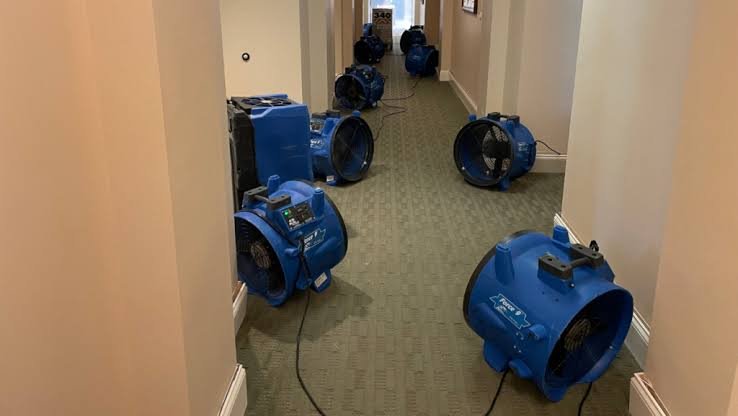
Following extraction, the structural drying phase begins. This involves a strategic deployment of commercial low-grain-dehumidifiers (LGDs) and high-velocity air movers. Unlike standard fans, commercial air movers produce a high volume of directed airflow across floors, walls, and ceilings, forcing trapped moisture to evaporate rapidly into the air. Simultaneously, industrial dehumidifiers draw the moisture-laden air out of the room, condensing and expelling the water safely outside. This continuous cycle drops relative humidity to safe levels, pulling moisture out of deep structural cavities and rendering the environment completely inhospitable to mold growth.
Professional Cleaning, Sanitization, and Antimicrobial Application
Drying a structure is only half the battle; ensuring that the environment is chemically safe and sterile is equally crucial to preventing mold outbreaks. Floodwaters and plumbing backups often carry contaminants, bacteria, and organic waste that can accelerate mold growth and create severe health hazards.
A certified water damage cleanup service applies specialized antimicrobial and antifungal treatments to all affected surfaces. These professional-grade solutions do not just mask odors; they actively neutralize mold spores, bacteria, and pathogens at the cellular level. Technicians thoroughly clean, sanitize, and deodorize structural elements, HVAC systems, and salvageable contents. By treating surfaces with EPA-registered disinfectants, professionals create a protective barrier that inhibits future mold germination, even if minor ambient humidity fluctuates in the days following the incident.
Specialized Handling of Porous Materials and Contaminated Content
Not all materials react to water the same way. While hard surfaces like tile, metal, and sealed concrete can be easily cleaned and dried, porous materials present a significant challenge. Items such as saturated insulation, heavily soaked drywall, carpet padding, and particle board furniture often absorb water to a point where they cannot be safely restored.
When porous materials are deeply infiltrated by water and remain wet for extended periods, they become prime real estate for mold roots that cannot be washed away. A professional water damage cleanup service possesses the expertise to evaluate which items can be salvaged through specialized restoration techniques and which must be safely removed and disposed of. By carefully tearing out irreparably damaged drywall and insulation, professionals eliminate the primary food sources for mold, stopping a potential infestation before it starts and protecting the rest of the building from cross-contamination.
Protecting Indoor Air Quality and Health
One of the most immediate benefits of hiring a water damage cleanup service is the preservation of indoor air quality. When water damage occurs, mold spores multiply rapidly and become airborne. Every time the HVAC system kicks on or people walk across damp carpets, these spores circulate throughout the entire home or commercial building. Inhaling high concentrations of mold spores can lead to severe health consequences, particularly for vulnerable populations such as children, the elderly, individuals with compromised immune systems, and those suffering from asthma or chronic respiratory conditions.
Professionals use negative air pressure machines equipped with High-Efficiency Particulate Air (HEPA) filters to isolate the affected work zones. These HEPA air scrubbers capture microscopic mold spores, dust, and airborne contaminants as small as 0.3 microns, purifying the air in real-time. By maintaining a clean, filtered indoor environment during the drying and restoration process, a water damage cleanup service ensures that occupants are not exposed to toxic airborne mold structures.
Long-Term Cost Savings and Peace of Mind
Many property owners hesitate to hire a professional water damage cleanup service due to concerns about upfront costs, attempting instead to clean up the mess themselves. However, this DIY approach frequently backfires, leading to catastrophic financial consequences down the road.
If hidden moisture is left behind during a DIY cleanup, a severe mold infestation will almost certainly develop within weeks. Remediating a widespread mold problem requires extensive containment, demolition, professional testing, and costly reconstruction—expenses that far exceed the initial cost of professional water damage restoration. Furthermore, severe mold damage can drastically reduce property value and complicate insurance claims, as many standard insurance policies do not cover damage caused by long-term neglect or unaddressed moisture.
By investing in a prompt response from a qualified water damage cleanup service, property owners save money in the long run. Professionals ensure the job is done right the first time, providing detailed moisture logs and documentation that satisfy insurance requirements and guarantee a dry, mold-free environment.
Conclusion
Water damage is an unpredictable and destructive force, but it does not automatically have to lead to a mold disaster. The timeline between a minor moisture issue and a major mold infestation is remarkably short, leaving little room for error or delay. While household tools and DIY drying methods may give a false sense of security, they leave deep structural moisture untouched and vulnerable to fungal growth.
A professional water damage cleanup service brings advanced technology, rigorous methodologies, and deep industry expertise to every phase of restoration. From thermal imaging and industrial-grade extraction to structural drying, antimicrobial sanitization, and air purification, these specialists eradicate moisture at its core. By stopping mold before it has a chance to grow, a water damage cleanup service protects the health of building occupants, preserves the structural integrity of the property, and provides invaluable peace of mind when disaster strikes.